AMENDMENT PROCESS
What’s already happened:
January 2025: The “Reproductive Freedom Amendment” was introduced and passed by both chambers of the General Assembly.
What’s coming next:
November 2025: Pro-abortion politicians will attempt to win a majority of House of Delegate seats.
January 2026: If successful, pro-abortion politicians will reintroduce the “Reproductive Freedom Amendment”, to pass the amendment with a House and Senate majority.
January 2026: The General Assembly passes legislation to put the question on the ballot, signed by the Governor.
November 2026: The amendment will appear on the ballot in the November 2026 general election and Virginia voters decide whether to make abortion a constitutional right.
If passed with a majority vote, Virginia adopts some of the most extreme abortions laws in the country and becomes an abortion destination.
Each state has its own process and timeline for amending its constitution. In Virginia, the two-year process—though lengthy—is intentionally designed to prevent rushed decisions. Any proposed amendment must pass multiple political and procedural hurdles before appearing on the ballot. For the pro-life movement, this is encouraging news: it gives us time and opportunity to organize, educate, and advocate effectively before any vote is held.
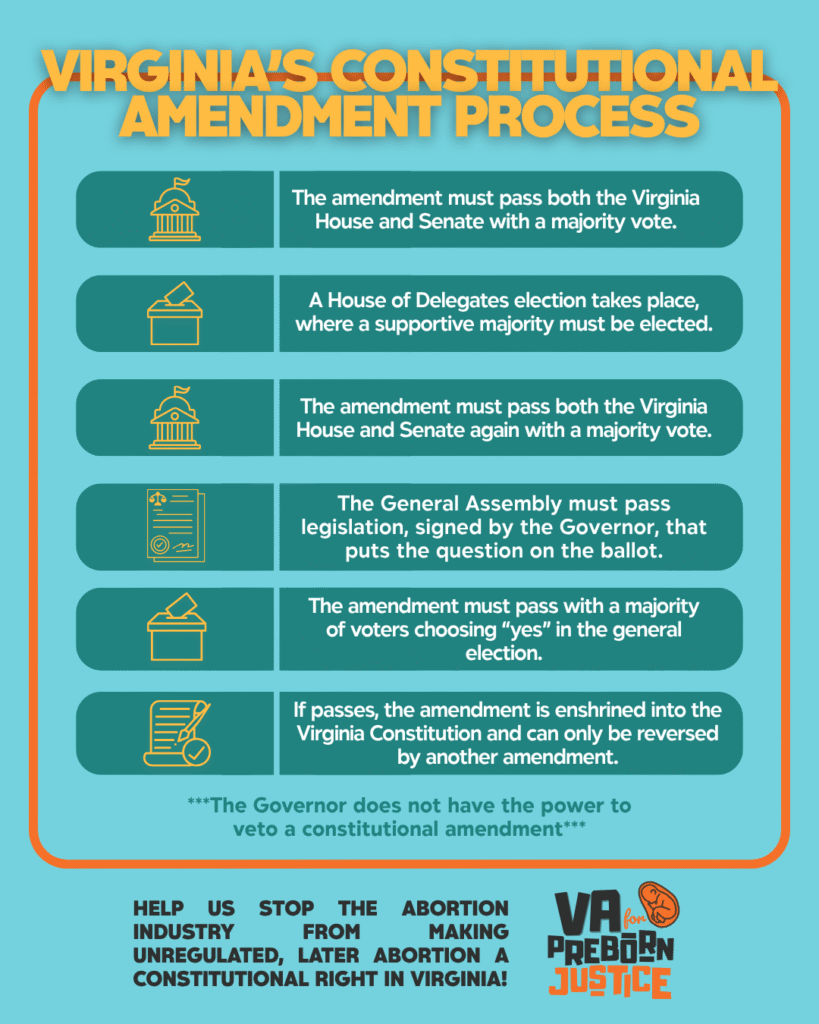
Here is a quick breakdown of the Virginia constitutional amendment process:
The amendment must pass both the Virginia House and Senate with a majority vote.
A House of Delegates election takes place where a supportive majority must be elected.
The amendment must pass both the Virginia House and Senate again with a majority vote.
The General Assembly must pass legislation, signed by the Governor, that puts the question on the ballot.
The amendment must pass with a majority of choosing “yes” in the general election.
If the amendment passes it is enshrined into the Virginia Constitution and can only be reversed by another amendment.
It is important to note that the Governor cannot veto a constitutional amendment—this process is entirely in the hands of the General Assembly and the voters.
Let’s walk through where we are right now in Virginia’s abortion amendment timeline, based on the outline above: